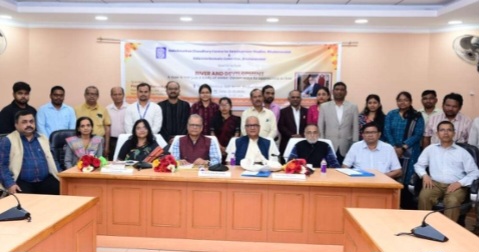
Bhubaneswar:The Nabakrushna Choudhury Centre for Development Studies (NCDS), Bhubaneswar, organized a special academic lecture titled “River and Development A River is Not Just a Body of Water for a rigorous and reflective engagement on the multidimensional role of rivers in development, ecology, culture, and governance.
The session was chaired by Prof. Pralay Kanungo, Leiden University, the Netherlands, who conceptualized the river as a “place of imagination.” He noted that rivers transcend their physical form to inspire memory, creativity, and reflection, symbolizing life, continuity, change, and time. Referring to rivers as “Mother,” Prof. Kanungo emphasized society’s ethical responsibility to protect rivers asserting that caring for rivers is integral to safeguarding life. culture. and future generations.
The keynote lecture was delivered by Prof. Peter Ronald deSouza, former Director, Indian Institute of Advanced Study (I1AS), Shimla, who presented an interdisciplinary framework for understanding rivers beyond conventional hydrological perspectives. Drawing on empirical examples such as the Narmada river disputes, he highlighted the complex interconnections between rainfall patterns, biodiversity, species survival, and the ecological foundations necessary for sustaining healthy river systems.
Introducing time as the third dimension of rivers, Prof. deSouza stressed that rivers must be understood as dynamic entities shaped by historical processes, political negotiations, and future developmental choices.Prof. deSouza further elaborated on eleven ways of appreciating a river, including as a repository of memory, a witness to history, a site of biodiversity, a provider of ecosystem services, a source of livelihoods and institutions, a cultural and cosmic resource, and a site of politics. Emphasizing that rivers belong to cultural communities, he underscored the need for public awareness, community participation, and strict enforcement of environmental laws to ensure their protection. He also observed that Odisha holds significant potential to replicate and scale sustainable river governance models.
The programme commenced with a documentary screening on “The River Mhadei, which offered a compelling visual and contextual foundation for the ensuing deliberations.
Ms. Rashmi Kabi, Secretary, NCDS, reflected on the alignment between the lecture’s theme and the broader institutional vision of NCDS. Kabi expressed sincere gratitude to Prakash Chandra Mohanty, Director, NCDS, for his visionary leadership and continued encouragement. The programme witnessed the presence of Prof. Mitali Chinara, Chairman, PG Council, Utkal University, Prof. Surya Narayan Mishra, Dr. Raj Kumar Khosla: Dr. Sandhya R. Mahapatro and Dr. Biswabas Patra.