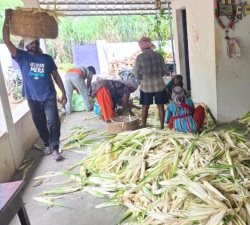
Chatrapur: Tata Steel Foundation (TSF) has enabled a sustainable livelihood model for vulnerable families in Odisha’s Ganjam district by establishing a community-owned Kewda distillation plant at Kalipalli village, near the Tata Steel Special Economic Zone at Gopalpur.
Kalipalli village in Chatrapur block is naturally endowed with perennial kewda plants (Pandanus fascicularis), whose male flowers are distilled to produce kewda perfume—an aromatic essence widely used in food flavouring and tobacco, with strong demand in international markets, particularly in Arab countries. Despite this rich traditional resource base, local harvesters had long earned limited returns by selling raw flowers through intermediaries.
Recognising this untapped economic opportunity, TSF facilitated the formation of the Kalipalli Youth Kewda Society, comprising 20 vulnerable families with 115 members, and supported the establishment of a Kewda distillation plant during FY 2023–24. To ensure long-term sustainability and true community ownership, the Society entered into a 15-year land lease agreement for operating the facility.
“This initiative reflects our commitment to building resilient and self-reliant communities by leveraging local resources,” said Dr. Jayant Kumar Tripathy, Unit Lead, TSF, Gopalpur. “By enabling community ownership, we are helping families transition from subsistence livelihoods to sustainable prosperity.”
The project was designed to shift communities from selling raw flowers to value-added processing, enabling their direct participation across the kewda value chain.
While the community contributed towards infrastructure development, utilities, labour and lease costs, Tata Steel Foundation extended one-time support of ₹29.75 lakh towards copper materials and distillation equipment, reinforcing principles of shared ownership and accountability.
“Earlier, we depended entirely on agents to sell kewda flowers. Today, we process our own produce and earn far better returns,” said Bangari Srinivas, President, Kallipalli Youth Kewda Society.
Kewda harvesting in Kalipalli occurs across two seasons—from March to September and November to January—with entire families actively engaged in the process. In the last production cycle, the Society produced 22 kg of kewda ruh (essential oil), registering a net profit of ₹20.40 lakh.
“This initiative has brought stability to our income and confidence about the future,” said B. Dharama Patro, Secretary of the Society.