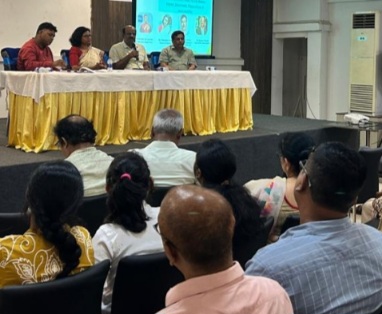
Bhubaneswar: An interactive session on “Heatwaves, Health Risks & Weather Reporting” was organised, here on Wednesady, jointly by Socratus Foundation for Collective Wisdom, Odisha Environment Congress, and Asar Social Impact Advisors.
The workshop brought together journalists, climate experts, scientists, public health professionals and civil society organisations to discuss the growing challenges posed by heatwaves and the need for responsible and informed reporting on heat-related risks.
The event began with opening remarks by Virat Singh from ASAR Social Impact Advisors and Siddhant from Socratus Foundation, who highlighted the increasing urgency of addressing heatwaves not merely as weather events, but as interconnected climate, health, governance, and livelihood challenges.
Prof. Debadatta Swain from IIT Bhubaneswar spoke on the scientific understanding of heatwaves and explained the difference between actual temperature and felt temperature. He also discussed the difference between Wet Bulb Temperature and Dry Bulb Temperature and stressed that many slow and cumulative impacts of heat on health are often neglected in public understanding.
Dr. Ashutosh Acharya from Aurassure presented data and visualisations showing how increasing urbanisation and concretisation have significantly increased temperatures across Bhubaneswar city. He discussed the Urban Heat Island effect and highlighted how journalists can use data, visualisation tools, storytelling techniques, and hyperlocal narratives to better communicate heat-related risks and vulnerabilities to the public.
The panel discussion featured Dr. Manorama Mohanty, Director of India Meteorological Department (IMD), Bhubaneswar; Dr. Arabinda Mishra, Chairperson of Development and Environment Futures Trust; and Mr. Bhabani Tripathy, Group News Editor of Sambad & Kanak News. The session was moderated by Anuj Das from Kanak News.
Dr. Arabinda Mishra highlighted that the impact of heat on children differs significantly, often resulting in blisters, rashes, sleep disruption, and cognitive stress.
Mr. Bhabani Tripathy emphasized the need for multi-actor platforms in both policy making and implementation. He stated that Heat Action Plans should not remain limited to administrative structures alone but should actively involve academicians, scientists, practitioners, CSOs, media institutions, and community stakeholders to develop more comprehensive and practical heat governance systems.
Dr. Manorama Mohanty from IMD stressed the importance of responsible reporting and cautioned against fear-based communication that may create unnecessary panic among the public.
The workshop also discussed the need for occupational heat safety protocols, climate volunteer cadres or “Heat Mitras,” public cooling infrastructure, shaded public spaces, drinking water kiosks, revised school timings during extreme heat conditions, and Urban Heat Island mapping for major cities.
Bollywood actor Naseeruddin Shah’ s short film “It’s Only 47°C” was screened on this occasion. The film highlighted the unequal impact of heat on traffic personnel, gig workers, rickshaw pullers, farmers, homemakers, and other vulnerable groups.
The workshop concluded with closing remarks by Mr. Sudarshan Das from Odisha Environment Congress, who emphasized the need for collaborative action, stronger public engagement, and long-term climate resilience planning to address the growing heat crisis across Odisha.
The organisers stated that the workshop aimed to strengthen media understanding of heatwaves, improve climate-health communication, and build stronger coordination between scientific institutions, governance systems, and journalists for responsible and people-centric heat reporting.